Projekt Kategorie Transport
H2 Pipeline Vlieghuis-Ochtrup

Thyssengas is constructing a cross-border hydrogen pipeline between Vlieghuis in the Netherlands and Ochtrup in the Steinfurt district of North Rhine-Westphalia, which is scheduled for completion in 2027. For this project, an existing natural gas pipeline with a length of approximately 53 kilometers will be converted for hydrogen transport. The pipeline will connect the emerging Germany-wide hydrogen network with the Dutch import ports of Amsterdam, Eemshaven, and Rotterdam, as well as the province of Zeeland with its storage facilities and planned production plants.
The pipeline project is being carried out by Thyssengas as a transmission system operator and is part of the GetH2 consortium, which is jointly developing the hydrogen infrastructure in Germany.
The Vlieghuis-Ochtrup hydrogen pipeline is scheduled to go into operation at the end of 2027. The border crossing point forms a central hub for cross-border hydrogen transport between Germany and the Netherlands.
Syneqt (GET H2 Nukleus)
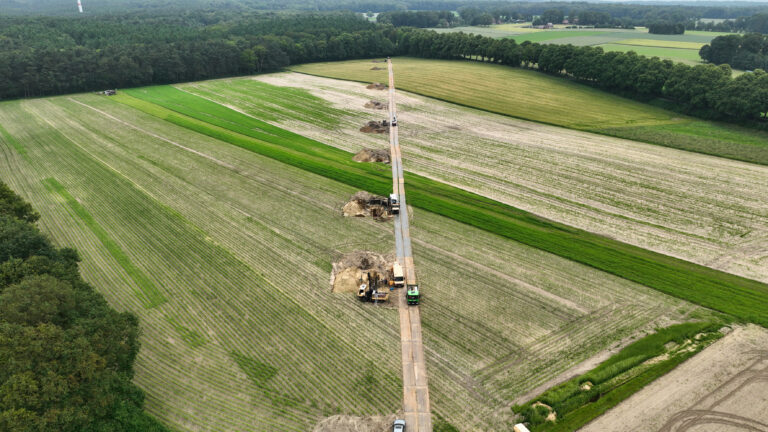
Syneqt's pipeline system connects the Marl Chemical Park and the Scholven refinery in North Rhine-Westphalia with the hydrogen core network. The total route comprises more than 50 kilometers of operational pipeline, 41 kilometers of which were converted from an existing natural gas pipeline to hydrogen. In addition, new sections were built, including a three-kilometer pipeline through the Marl Chemical Park and a ten-kilometer connection to the refinery in Gelsenkirchen-Scholven. The system enables the transport of up to 50,000 tons of hydrogen per year and brings climate-neutral hydrogen directly to industrial customers.
The project is part of the GET H2 Nucleus initiative and was implemented by Evonik together with partners from the hydrogen value chain. The aim is to connect the climate-neutral production of green hydrogen in northern Germany with industrial customers in North Rhine-Westphalia and Lower Saxony.
Syneqt completed work on the entire pipeline route from Legden via Marl to Gelsenkirchen-Scholven in just under two years of intensive project work. Six stations were included in the conversion. The pipeline strengthens the role of the Marl Chemical Park as a hydrogen hub."
H2-Cluster-Heek
The Heek-Epe (HEP) hydrogen pipeline connects the existing pipeline number 13, which is being converted from natural gas to hydrogen transport, with the cavern field in Epe in the district of Borken in North Rhine-Westphalia. The new pipeline has a total length of 11 kilometers and a design pressure of 70 bar. The pipeline construction will connect to RWE Gas Storage West's first hydrogen storage facility in Epe, enabling large-volume hydrogen storage in caverns.
The project is being implemented by OGE (Open Grid Europe) and is part of the development of the core hydrogen infrastructure in North Rhine-Westphalia. The HEP pipeline forms a central link between the supraregional hydrogen transport network and the local storage infrastructure in Epe.
Once completed, it will create an important infrastructure component for the hydrogen economy in the Münsterland region, ensuring the transport and storage of hydrogen between Heek and Epe.
New construction hydrogen pipeline Heek-Epe (HEP)
The Heek-Epe (HEP) hydrogen pipeline connects the existing pipeline number 13, which is being converted from natural gas to hydrogen transport, with the cavern field in Epe in the district of Borken in North Rhine-Westphalia. The new pipeline has a total length of 11 kilometers and a design pressure of 70 bar. The pipeline construction will connect to RWE Gas Storage West's first hydrogen storage facility in Epe, enabling large-volume hydrogen storage in caverns.
The project is being implemented by OGE (Open Grid Europe) and is part of the development of the core hydrogen infrastructure in North Rhine-Westphalia. The HEP pipeline forms a central link between the supraregional hydrogen transport network and the local storage infrastructure in Epe.
Once completed, it will create an important infrastructure component for the hydrogen economy in the Münsterland region, ensuring the transport and storage of hydrogen between Heek and Epe.
H2HoWi

The H2 Howi project in Holzwickede, North Rhine-Westphalia, is testing the conversion of existing natural gas pipelines to transport 100 percent hydrogen. The goal is to demonstrate the technical feasibility and legal framework for such a conversion for the first time in Germany, thereby enabling a green application for the existing natural gas network. The project focuses on demonstrating in practice that the existing gas infrastructure in Holzwickede is suitable for transporting pure hydrogen and can thus contribute to the decarbonization of the energy supply.
The project is being carried out by Westenergie and is continuously monitored by scientists. The scientific monitoring documents all technical and regulatory findings that are relevant for future hydrogen projects in the gas network. The H2 Howi project is playing a pioneering role in the development of the hydrogen economy in Germany.
The H2 Howi project was commissioned in October 2022. The project is scheduled to run until December 2026 in order to gain comprehensive long-term experience with the operation of hydrogen in converted natural gas pipelines. The data and findings obtained will serve as the basis for the large-scale transformation of the gas infrastructure in North Rhine-Westphalia and nationwide.
mosaHYc Moselle-Saar-Hydrogen-Conversion

The mosaHYc project involves the construction of a cross-border hydrogen infrastructure between Saarland and the French region of Grand Est with a total length of around 90 kilometers. In the German section, a new hydrogen pipeline with an internal diameter of approximately 60 centimeters will be built between Leidingen and Dillingen an der Saar, and an existing pipeline between Völklingen-Fürstenhausen and Carling will be reactivated. The network connects electrolysers at the Carling, Fenne, and, in the future, Perl sites with industrial customers in the greater region. The project is being carried out by Creos Deutschland Wasserstoff GmbH in cooperation with the French network operator naTran. In July 2024, the Federal Ministry for Economic Affairs and Climate Protection approved funding of €44 million, of which around €31 million will come from federal funds and the remainder from the Saarland. Construction is scheduled to begin in early 2026, with commissioning planned for the end of 2027.
New Pipeline Construction 500/500.1 & 501
Hydrogen pipelines 500 and 500.1 connect RWE Generation's 300 MW electrolysis plant at the Lingen-Hanekenfähr power plant site in the district of Emsland, Lower Saxony, with the Nowega distribution station in Schepsdorf, southwest of Lingen. Pipeline 500 runs for 2,250 meters from the power plant site to the Schepsdorf station, crossing the Ems River and the Dortmund-Ems Canal. Connection pipeline 500.1 covers 460 meters on the power plant site to the electrolyzer. Both pipelines have a nominal diameter of DN 500 and are operated at up to 70 bar operating pressure. At the Schepsdorf station, the pipeline connects to pipeline 40b in the direction of Nordhorn for onward transport to industrial customers in the Ruhr area.
The project is being carried out by Nowega GmbH and is part of the GET H2 Nukleus initiative.
Conversion of Lines 40b, 43, and 60
Lines 40b, 43, and 60 connect Lingen in Emsland with Bad Bentheim in the district of Grafschaft Bentheim in Lower Saxony and form an important section of the GET H2 hydrogen network currently under construction.
The three line sections cover a total of around 51 kilometers: Line 40b extends over 22 kilometers from the Messingen station southeast of Lingen via the Schepsdorf network node to the Frenswegen station northwest of Nordhorn. Line 43 runs for 11 kilometers from the Schepsdorf station to the Holthausen II station with a connection to bp Lingen, and Pipeline 60 runs for 18 kilometers from the Frenswegen station to the Bentheim station. The pipelines operate at a working pressure of 70 bar. The converted natural gas pipelines are used to transport green hydrogen from Lingen, where hydrogen is to be produced from wind power, to industrial customers in the northern Ruhr area.
The project was implemented by Nowega GmbH and is part of the GET H2 Nukleus project, which is being realized in collaboration with partners OGE, RWE, and Evonik.
Pipelines 40b and 60 have been operational since the successful conversion and are transporting hydrogen.
Conversion Line 13
The conversion of pipeline 13 involves an existing natural gas pipeline with a length of approximately 31 km and a design pressure of 64 bar, which runs between Emsbüren in Lower Saxony and Legden in North Rhine-Westphalia. The pipeline connects the municipalities of Bad Bentheim, Ochtrup, Heek, Nienborg, and Asbeck in the Münsterland region and will be gradually converted to hydrogen transport.
The infrastructure is part of the GET H2 Nucleus network and serves to supply industrial customers in the region with hydrogen. The project is being implemented as part of the IPCEI program and is funded by the federal government. The conversion is being carried out in partnership with regional network operators and energy suppliers, who are upgrading the existing pipeline network for hydrogen transport. The complete conversion to hydrogen is expected to be completed by 2027. As part of the project, the Westerbauerschaft, Nienborg, Heek, and Emsbüren stations, as well as the Ochtrup Wester site, will be dismantled and rebuilt. In addition, new stations will be built in Bad Bentheim, Ochtrup, and Asbeck, and a connecting pipeline will be constructed in Legden.
DoMa GET H2 Nukleus
The DoMa (Dorsten-Marl) hydrogen pipeline connects the starting point in Dorsten with the Marl Chemical Park in the district of Recklinghausen over a length of around 9 kilometers. The new pipeline connects to pipeline number 13, which is being converted from natural gas to hydrogen transport, and enables industrial companies in the chemical industrial park to connect to the GET H2 NETZ.
The project is being implemented by Open Grid Europe GmbH (50%) and Nowega GmbH (50%) and has been confirmed as an IPCEI project (Hy2Infra) by the EU Commission. Funding is provided by the Federal Ministry for Economic Affairs and Energy and the Ministry of Economic Affairs, Industry, Climate Protection and Energy of the State of North Rhine-Westphalia.
Commissioning is scheduled for 2027.