
Projekt Kategorie Import
H2-Cluster-Heek
The Heek-Epe (HEP) hydrogen pipeline connects the existing pipeline number 13, which is being converted from natural gas to hydrogen transport, with the cavern field in Epe in the district of Borken in North Rhine-Westphalia. The new pipeline has a total length of 11 kilometers and a design pressure of 70 bar. The pipeline construction will connect to RWE Gas Storage West's first hydrogen storage facility in Epe, enabling large-volume hydrogen storage in caverns.
The project is being implemented by OGE (Open Grid Europe) and is part of the development of the core hydrogen infrastructure in North Rhine-Westphalia. The HEP pipeline forms a central link between the supraregional hydrogen transport network and the local storage infrastructure in Epe.
Once completed, it will create an important infrastructure component for the hydrogen economy in the Münsterland region, ensuring the transport and storage of hydrogen between Heek and Epe.
H2HoWi

The H2 Howi project in Holzwickede, North Rhine-Westphalia, is testing the conversion of existing natural gas pipelines to transport 100 percent hydrogen. The goal is to demonstrate the technical feasibility and legal framework for such a conversion for the first time in Germany, thereby enabling a green application for the existing natural gas network. The project focuses on demonstrating in practice that the existing gas infrastructure in Holzwickede is suitable for transporting pure hydrogen and can thus contribute to the decarbonization of the energy supply.
The project is being carried out by Westenergie and is continuously monitored by scientists. The scientific monitoring documents all technical and regulatory findings that are relevant for future hydrogen projects in the gas network. The H2 Howi project is playing a pioneering role in the development of the hydrogen economy in Germany.
The H2 Howi project was commissioned in October 2022. The project is scheduled to run until December 2026 in order to gain comprehensive long-term experience with the operation of hydrogen in converted natural gas pipelines. The data and findings obtained will serve as the basis for the large-scale transformation of the gas infrastructure in North Rhine-Westphalia and nationwide.
Hydrogen cavern storage facility Epe H2
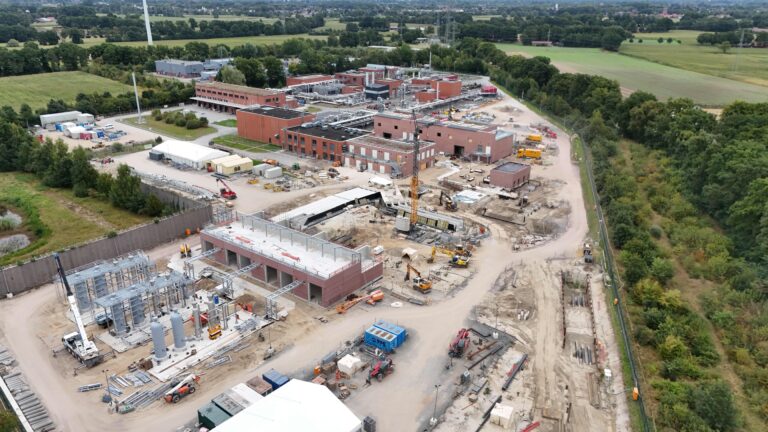
The Epe H2 hydrogen cavern storage facility is being built at the Kottiger Hook site in Gronau-Epe in the district of Borken, North Rhine-Westphalia. The storage project comprises two salt caverns at a depth of around 1,000 meters with a usable working gas volume of 38 million cubic meters of hydrogen. The storage and withdrawal capacity is 50,000 cubic meters per hour in each case. The storage facility will be connected to the GET H2 network, which comprises the hydrogen pipeline between Lingen and the Ruhr area, via the HEp (Heek-Epe) hydrogen pipeline. The facility will serve to buffer fluctuating hydrogen production from renewable energies and enable demand-oriented supply to industrial customers in North Rhine-Westphalia and Lower Saxony.
The project is being implemented by RWE Gas Storage West GmbH as the sole operator. The project is funded as part of the IPCEI (Important Project of Common European Interest) program Hy2Infra. Funding is provided by the Federal Ministry of Economics, the state of North Rhine-Westphalia, and the federal government.
Commercial operation is scheduled to begin on July 1, 2027. With a storage capacity of 38 million cubic meters and a capacity of 50,000 cubic meters per hour for both injection and withdrawal, the facility in Gronau-Epe will be Germany's first commercial hydrogen cavern storage facility.